Why Your Evening Walk Isn't Calming You Down
I used to grab my headphones, queue up a podcast, and march through the neighborhood at sunset. I thought I was unwinding. But my mind was still racing, my shoulders were still tight, and I often felt more drained than relaxed when I got home. The problem wasn't the walk - it was how I was walking.
Most people treat an evening walk as a background activity. They scroll through Instagram, respond to texts, or listen to a high-energy playlist. That's not a walk for calm. That's a walk with a distraction soundtrack. The kind of evening walk that actually lowers cortisol and shifts your nervous system into rest mode requires a different approach: a deliberate, unplugged, sensory-rich experience.
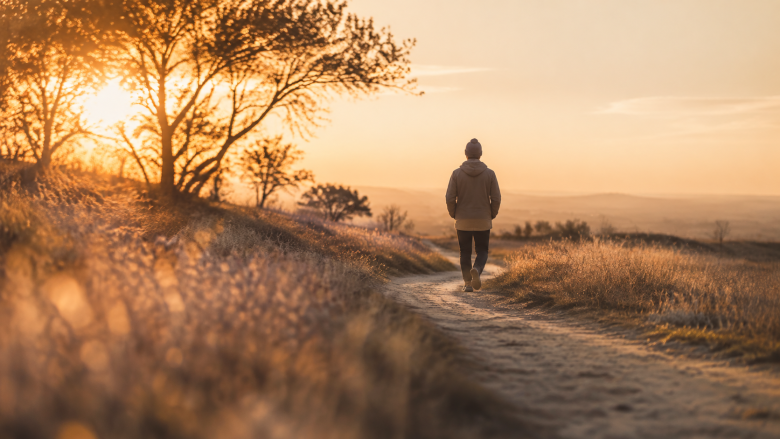
After years of experimenting (and failing) with various evening routines, I landed on a method that transformed my evenings. I call it the silent walk. No phone, no music, no agenda. Just me, the pavement, the fading light, and a few simple mindfulness techniques. Below, I'll share exactly how to do it, why it works, and how to adapt it when life gets in the way.
The Science of the Evening Walk for Calm
Don't take my word for it. The research is clear: an evening walk done right taps into your biology in ways that scrolling or zoning out cannot.
Circadian Rhythm and Light Exposure
Your body's internal clock, the circadian rhythm, is heavily influenced by light. Exposure to natural daylight during the morning helps set your sleep-wake cycle, but evening light matters too. According to the National Institute of General Medical Sciences, dim light in the evening signals your brain to produce melatonin. An evening walk, especially as the sun is setting, exposes you to the right kind of low-angle, blue-diminished light that tells your body it's time to wind down.
Most people don't realize that walking under bright streetlights or staring at a phone screen during a walk can suppress melatonin production by up to 50%. The silent walk removes that screen interference entirely.
Cortisol Reduction and Parasympathetic Activation
Chronic stress keeps your sympathetic nervous system (fight-or-flight) in overdrive. A 2020 study published in Scientific Reports found that a 20-minute walk in nature, without electronic devices, significantly reduced salivary cortisol levels. The key was the combination of gentle movement, natural surroundings, and absence of digital stimulation.
When you walk without purpose, your body shifts into the parasympathetic (rest-and-digest) state. This is the opposite of the high-alert mode most of us carry all day. The simple act of putting one foot in front of the other, at a slow, rhythmic pace, activates the vagus nerve - the main highway of the parasympathetic system.
Grounding and Earthing
Some research suggests that direct contact between your skin and the earth (barefoot on grass, sand, or soil) can reduce inflammation and improve sleep quality. A review in the Journal of Environmental and Public Health noted that grounding can normalize cortisol rhythms. While you don't have to walk barefoot to benefit, the principle of being present with the ground beneath you is central to the silent walk.
How to Do a Silent Evening Walk: The 10-Minute Beginner Routine
If you've never done a truly unplugged evening walk, start small. The goal is not distance or speed. It's presence. Here's a step-by-step routine that takes 10 minutes, designed to build the habit without overwhelming you.
Step 1: Leave Your Phone at Home (or on Airplane Mode)
This is non-negotiable. If you're worried about safety, bring a basic phone for emergencies, but turn off all notifications. The moment you glance at a screen, your brain switches back to task mode. If you must use your phone for a flashlight or music, put it on airplane mode and tuck it in a pocket. Better yet, leave it behind entirely.
Step 2: Choose a Simple Route (No Decisions Needed)
Pick a route you know well - a loop around your block, a nearby park path, or a quiet side street. The route should be short enough that you don't need to think about directions. That mental freedom is part of the calm.
Step 3: Set an Intention, Not a Goal
Before you start walking, take three deep breaths. Then silently say to yourself: "I am walking to let go of today." That's it. No distance goals, no pace targets. Just an intention to release tension.
Step 4: Sync Your Breath with Your Steps
For the first two minutes, breathe in for four steps, hold for two steps, breathe out for four steps. This is a simple version of diaphragmatic breathing. It slows your heart rate and anchors your attention. After two minutes, let your breathing return to its natural rhythm - just notice it.
Step 5: Practice the 5-4-3-2-1 Grounding Technique
This is the core of the silent walk. For the next five minutes, cycle through your senses:
- 5 things you can see - a flickering streetlight, a patch of moss, the color of the sky.
- 4 things you can feel - the breeze on your skin, the ground under your feet, the texture of your shirt.
- 3 things you can hear - a distant car, birds settling down, your own footsteps.
- 2 things you can smell - cut grass, damp earth, someone's cooking.
- 1 thing you can taste - the air on your tongue, or just the absence of flavor.
If your mind wanders (and it will), gently guide it back to the next sense. This is not a test of concentration. It's a practice of returning.
Step 6: Walk in Silence for the Last 3 Minutes
Drop the technique. Just walk. Let your thoughts come and go like clouds. Notice how your body feels - lighter, heavier, looser? Don't judge. Don't hold on to any one thought. This is the space where calm really settles in.
The Thing Nobody Tells You About Evening Walks
Here's the hard truth: the first few times you try a silent walk, it will feel awkward. You'll feel the urge to check your phone. You'll hear the silence and think, "Is this boring?" Your brain will resist because it's used to constant input. The thing nobody tells you about evening walks for calm is that the discomfort is part of the process. It's a withdrawal from the dopamine hits of notifications. Stick with it for three or four walks, and the silence starts to feel like a relief.
I made the mistake of giving up after my first attempt. I thought, "This isn't working. I'm not relaxing." What I didn't realize is that I was trying to force relaxation, which is the opposite of what calm requires. Calm is not a feeling you can grab. It's a space you create and then allow yourself to fall into.
Overcoming Common Barriers to Evening Walks
Life gets in the way. Here's how to handle the most common obstacles.
Safety in Low Light
Darkness can feel unsafe, especially for women or anyone walking alone. The solution is not to skip the walk. It's to prepare. Wear reflective gear or a headlamp. Choose well-lit streets or a well-trafficked park loop. Consider walking with a dog (yours or a neighbor's). If you feel uneasy, walk in a parking lot of a closed retail store - they're often well-lit and empty. The goal is to feel secure enough to relax, not to prove anything.
Urban Noise and Traffic
You don't need a forest to get the benefits. A city sidewalk can work if you adjust your approach. Walk on quieter side streets rather than main roads. Use the noise as part of your grounding exercise - instead of fighting it, include it in your 5-4-3-2-1 practice. Hear the distant siren, feel the vibration of a bus passing. The intention is not to eliminate all stimuli, but to choose what you pay attention to.
Bad Weather
Rain, cold, or heat can be a legitimate barrier. But most people overestimate the discomfort. A light drizzle or cool breeze can actually enhance the sensory experience. If you're bundled appropriately, a walk in light rain feels almost meditative. For extreme weather, consider a covered parking garage or a large indoor mall (if it's open). But try to get outside at least a few times a week - the natural light and air are irreplaceable.
Lack of Time
You don't need an hour. Five to ten minutes of a focused silent walk is more effective than 30 minutes of distracted walking. If you're short on time, prioritize the breathing and grounding techniques over distance. As we covered in our guide to How to Start a Short Daily Walk Habit, a consistent short walk beats an occasional long one.
Mindfulness Techniques to Deepen Your Evening Walk
Once you've mastered the basic routine, you can layer in more advanced practices.
Gratitude Prompts
As you walk, silently name three things you're grateful for that happened today. They don't have to be big. A good cup of coffee. A kind word from a coworker. The fact that you're outside, moving. This shifts your brain from stress-focused to appreciation-focused. Research from the Harvard Health Publishing shows that regular gratitude practice increases long-term well-being.
Walking Meditation
This is a formal practice from Buddhist tradition. Walk very slowly - about half your normal pace. Focus on the sensations of lifting your foot, moving it forward, placing it down. When your mind wanders, bring it back to the foot. Do this for five minutes. It's surprisingly difficult, but it trains your brain to stay in the present.
Body Scan on the Move
Start at your feet and mentally scan upward. Notice any tension in your ankles, calves, knees, hips, back, shoulders, neck, jaw. As you identify a tense area, breathe into it. Imagine the breath softening that spot. This is particularly effective after a long day of sitting.
Why Walking While Scrolling Doesn't Work
Let's debunk the myth that any walk is a good walk. Walking while scrolling through social media, reading emails, or listening to a stressful podcast keeps your brain in a state of high alert. Your body is moving, but your mind is still processing information, making decisions, and reacting to stimuli. This is called dual-tasking, and it actually increases cortisol levels. A study from the International Journal of Environmental Research and Public Health found that walking while using a smartphone reduces the restorative benefits of nature exposure. You're essentially canceling out the calm.
If you want to listen to something, choose ambient sounds (rain, forest, ocean) or a guided meditation. Better yet, choose silence. The brain needs moments of zero input to consolidate memories, process emotions, and reset.
How to Build This Into Your Evening Routine
An evening walk for calm works best when paired with other wind-down rituals. For a deeper dive on creating a full evening unwind, see our article about How to Build a Relaxing Evening Ritual. The walk should ideally happen 30-60 minutes before you start your nighttime routine. It creates a buffer zone between the demands of the day and the rest of the evening.
After your silent walk, you might follow up with a gentle stretch. Check out our Evening Stretch Routine for Relaxed Muscles to release any remaining physical tension. The combination of a mindful walk and a few stretches can dramatically improve sleep quality.
If you're tracking your calm progress, you can use the Calm Tracker Calculator to monitor how your evening walks affect your stress levels over time. It's a simple tool that helps you see patterns - like which routes or times of day work best for you.
Urban Alternatives When Nature Isn't Near
You don't need a mountain trail. Try these ideas for city dwellers:
- Park loops: Most city parks have a circular path. Walk it twice, slowly. The repetition is calming.
- Quieter side streets: Walk one block away from the main road. The noise drops significantly.
- Empty parking lots: After business hours, a large parking lot is surprisingly quiet. The open space can feel expansive.
- Rooftop or balcony: If you can't leave home, walk in place on a balcony or rooftop while focusing on the sky.
- Indoor walking: In extreme weather, walk laps in your home. It's not the same, but the breathing and grounding can still work.
When to Skip the Evening Walk
I'll be honest: sometimes a walk is not the right choice. If you're exhausted to the point of dizziness, or if the weather is dangerously hot or icy, skip it. If you're feeling emotionally overwhelmed in a way that makes being outside feel unsafe, give yourself permission to rest. The goal is not to add another obligation to your day. It's to find a tool that helps you reset.
Trade-offs exist. On a very cold night, the discomfort of being cold may outweigh the benefits. On a very hot night, the exertion may raise your heart rate instead of lowering it. Learn to listen to your body. The silent walk is a practice, not a prescription.
The Long-Term Impact of Regular Silent Walks
After three months of doing this almost daily, I noticed changes that surprised me. My sleep quality improved. My racing thoughts at bedtime slowed down. I started to notice small details in my neighborhood I'd never seen before - a particular tree that changes color in the evening light, a fence that creaks when the wind hits it just right. The walk became a kind of anchor, a signal to my brain that the day is done.
Most people don't realize that the biggest benefit of an evening walk for calm isn't the immediate relaxation. It's the cumulative effect on your nervous system. Each walk trains your brain to shift more easily into rest mode. Over time, you become less reactive to stress during the day, because you've built a reliable off-ramp. The calm becomes a skill, not a lucky break.
If you're ready to start, don't overthink it. Put on comfortable shoes, leave your phone behind, and step outside. Walk slowly. Breathe. Notice. That's all it takes. The rest will follow.